

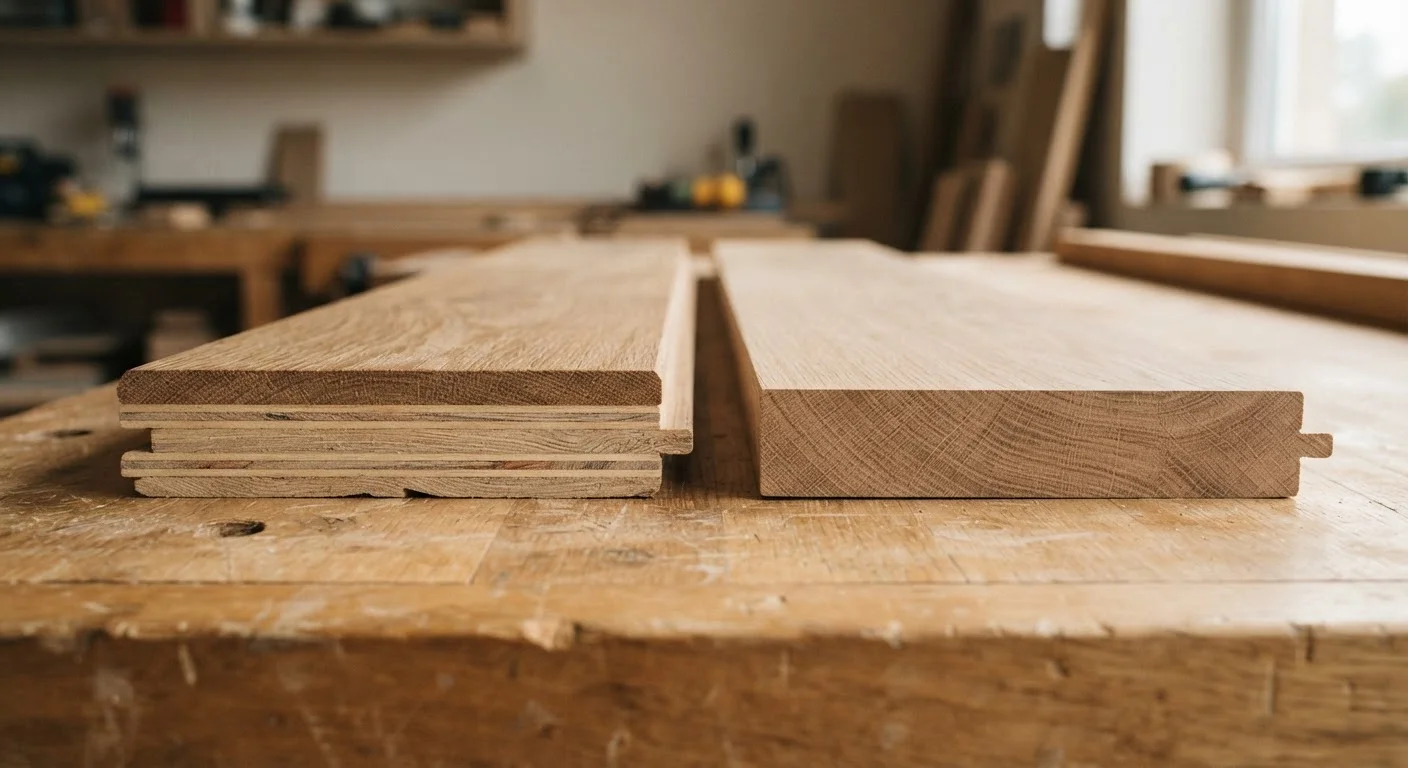
Option A
Engineered Hardwood
The dimensionally stable, moisture-resistant modern option.
Best for: Best for below-grade rooms, areas with humidity fluctuations, or homes where radiant heat is installed.
Option B
Solid Hardwood
The traditional, long-lasting floor with maximum refinishing potential.
Best for: Best for above-grade living spaces where longevity and repeated refinishing over decades matter most.
How Each Flooring Type Is Constructed
The most meaningful difference between these two flooring types starts at the structural level. Solid hardwood is milled from a single piece of wood - typically 3/4 inch thick - giving it a uniform grain structure throughout. That thickness is what makes repeated sanding and refinishing possible over the life of the floor.
Engineered hardwood, by contrast, is a layered product. A genuine hardwood veneer (called the wear layer) sits on top of multiple plies of plywood or high-density fiberboard (HDF). These core layers are oriented in alternating directions, which distributes stress and significantly reduces the wood's tendency to swell or shrink with changes in humidity. The wear layer ranges from about 1 mm to 6 mm depending on the product tier - thicker wear layers allow more refinishing cycles.
Both types feel like real wood underfoot and look virtually identical once installed. The construction difference only becomes critical when your environment or installation method introduces variables like moisture, heat, or a concrete subfloor.
| Criterion | Engineered Hardwood | Solid Hardwood |
|---|---|---|
| Core construction | Hardwood veneer over cross-ply plywood or HDF | Single solid piece of wood throughout |
| Typical thickness | 3/8" to 3/4" | 3/4" standard |
| Moisture resistance | Good - dimensionally stable | Poor - prone to expansion |
| Below-grade suitability | Yes (with proper prep) | Generally not recommended |
| Installation methods | Nail, staple, glue, or float | Nail or staple only |
| Refinishing potential | 1-3 times (wear layer dependent) | 4-8 times over lifespan |
| Radiant heat compatible | Yes (most products) | Limited - manufacturer specific |
Moisture Tolerance and Where You Can Install Each
Moisture is the central factor that separates these two materials in practical terms. Wood expands when it absorbs humidity and contracts when air dries out. Solid hardwood, being a single uniform piece, experiences this movement across its entire width - which is why it's not recommended for below-grade installations (basements) or rooms with consistently elevated moisture like full bathrooms.
Engineered hardwood's cross-ply core counters this movement, making it appropriate for basements, kitchens, and over radiant heating systems. That said, engineered hardwood is not waterproof. Prolonged standing water or flooding will damage either type.
35-55%
Recommended indoor relative humidity for wood floors
Most wood flooring manufacturers specify this range to minimize seasonal expansion and contraction in both engineered and solid products.
3-7 days
Typical acclimation period before installation
Flooring industry guidelines generally call for planks to acclimate to interior conditions before installation to reduce post-install movement.
Up to 6 mm
Maximum wear layer thickness in premium engineered hardwood
Wear layer depth determines how many times an engineered floor can be refinished - a key spec to verify before purchase.
Installation flexibility also differs. Solid hardwood must be nailed or stapled to a wood subfloor. Engineered hardwood can be nailed, stapled, glued down, or floated - a method where planks click together without fasteners, sitting loosely over an underlayment. Floating installation is not an option for solid hardwood, and glue-down over concrete is generally unsuitable for solid wood as well.
Refinishing Potential and Long-Term Durability
Refinishing - sanding down the surface and applying a fresh finish - restores a wood floor's appearance and removes scratches, stains, and wear patterns. How many times a floor can be refinished depends entirely on how much material sits above the tongue-and-groove fastening system.
A standard 3/4-inch solid hardwood plank can typically be sanded and refinished four to eight times across its life, depending on how aggressively each round removes material. This is what gives solid hardwood floors a multi-generational lifespan.
Engineered hardwood's refinishing potential is limited by its wear layer thickness. A 2 mm wear layer may support one light refinish; a 4-6 mm layer might allow two or three. Once that layer is exhausted, the floor must be replaced. For many homeowners, however, engineered hardwood still lasts 25-30 years before reaching that point - a reasonable lifespan for most renovation cycles.
When evaluating engineered products, ask specifically about the wear layer thickness in millimeters, not just the overall plank thickness. That number determines your long-term options more than any other specification.
Making the Right Choice for Your Space
Neither flooring type is objectively superior - the right choice depends on where you're installing, your subfloor type, your home's humidity profile, and how long you expect to stay in the space.
For main-level rooms with a plywood subfloor and stable indoor humidity, solid hardwood is a durable, refinishable investment. For basements, over concrete slabs, above radiant heat, or in any room where moisture is a variable, engineered hardwood's structural stability makes it the more practical choice.
Before installation, always acclimate wood flooring to your home's interior conditions - typically 3 to 7 days - and measure ambient humidity levels. Most wood floor manufacturers recommend maintaining indoor relative humidity between 35% and 55% year-round to minimize movement in either flooring type. Consult with a flooring professional to assess your specific subfloor conditions, and verify that your chosen product meets any applicable local building codes, particularly for below-grade or multi-family installations.
Just as material construction drives performance differences in other home products - much like the trade-offs between cutting board materials - understanding what's inside your flooring plank helps you invest in the right surface for your actual conditions.
The content on this site is provided for informational purposes only and should not be considered a substitute for professional advice. While we strive to provide accurate and up-to-date information, we make no guarantees regarding its completeness or accuracy. Always consult a qualified professional for advice specific to your circumstances before making any decisions.