

Why Electrical Myths Persist - and Why They Matter
Home electrical work sits in an unusual middle ground: some tasks genuinely are DIY-friendly for careful, informed homeowners, while others require licensed professionals and permits by law. The problem is that the line between the two is often misread, blurred by well-meaning advice passed down through generations or picked up from online videos that skip critical context.
Electrical mistakes don't always fail immediately. A miswired outlet or an undersized connection may work for months before heat buildup, arcing, or a fault creates a fire or shock hazard. That delayed feedback loop is part of what makes wrong assumptions so persistent - and so dangerous. The myth-and-fact pairs below address the most common misconceptions our editorial team encounters, grounded in how the NEC and electrical safety science actually work.
Myth
If I flip the breaker off, the wires in that circuit are completely safe to handle.
Fact
Some conductors in your walls remain energized regardless of which breaker you switch off, including the service entrance wires feeding the panel itself.
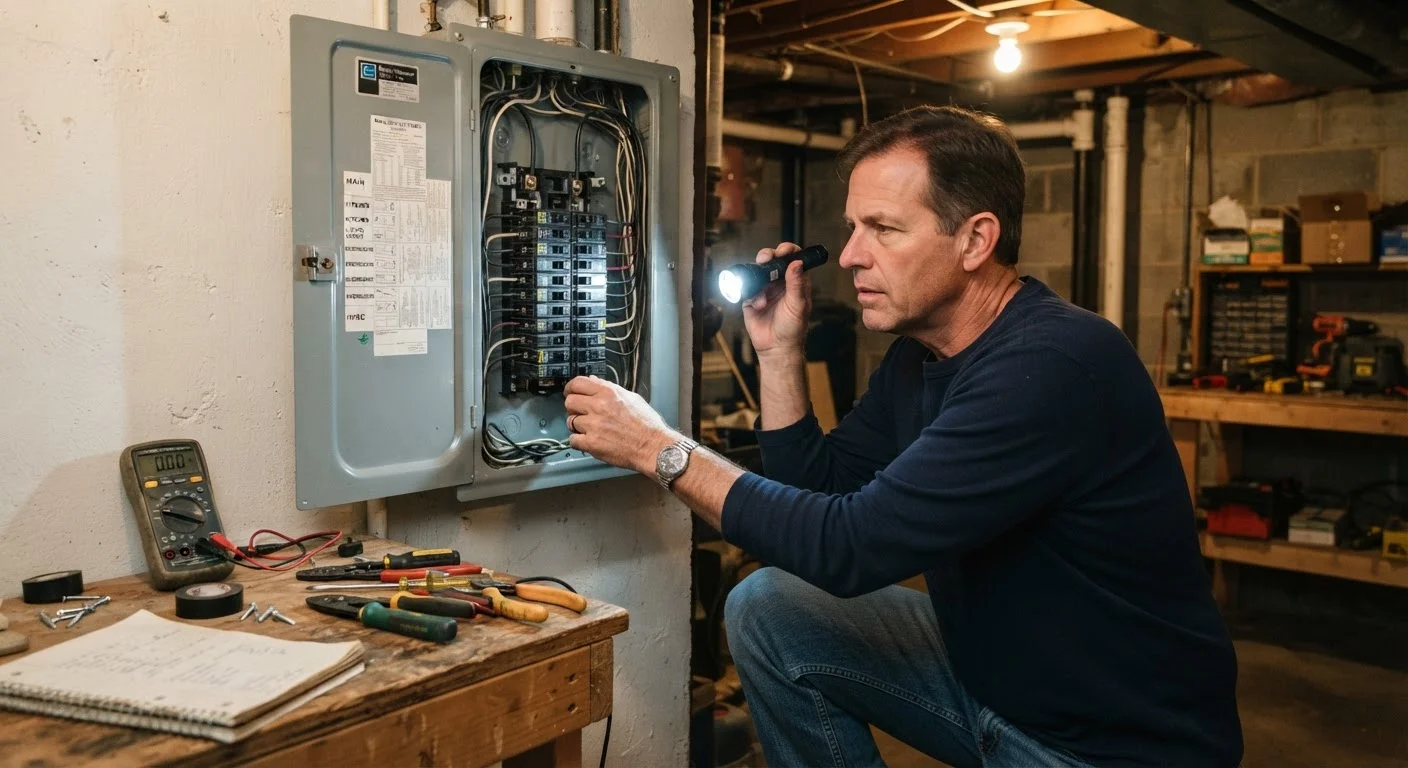
A tripped or switched-off breaker de-energizes only the wires downstream of that breaker. The cables entering your main panel from the utility - called service entrance conductors - are live at all times, even when the main breaker is off. Additionally, multi-wire branch circuits and shared neutrals can leave unexpected conductors energized. Always use a non-contact voltage tester on every wire you intend to touch, even after cutting the breaker.
Myth
A larger breaker is an easy fix if my circuit keeps tripping.
Fact
Breakers are sized to protect the wire gauge, not the device load. Upsizing a breaker without upgrading the wire creates a fire hazard.
The circuit breaker's job is to interrupt current before the wire overheats. A 15-amp breaker paired with 14-gauge wire is intentional - that wire can only safely carry 15 amps. Installing a 20-amp or 30-amp breaker on the same wire means the breaker will no longer trip before the conductor reaches dangerous temperatures. The correct solution is to identify why the circuit is overloaded and either redistribute loads or have a licensed electrician run a new, appropriately sized circuit.
Myth
Electrical tape is a reliable, permanent way to insulate a splice or repair damaged wire insulation.
Fact
Electrical tape is rated for temporary use and degrades over time; the National Electrical Code (NEC) requires splices to be made inside approved junction boxes with proper connectors.
Electrical tape loses adhesion and elasticity as it ages, especially in areas with temperature swings. The NEC mandates that all wire splices occur inside a listed junction box that remains accessible - not buried in a wall or ceiling. Properly sized wire nuts or push-in connectors, contained in a covered box, provide the mechanical protection and accessibility that tape alone cannot offer.
Myth
Installing a GFCI outlet means I don't also need AFCI protection on that circuit.
Fact
GFCI and AFCI devices protect against completely different hazards and are not substitutes for each other.
A Ground Fault Circuit Interrupter (GFCI) detects current leaking to ground - the type of fault that can electrocute a person who becomes part of the path. An Arc Fault Circuit Interrupter (AFCI) detects the electrical arcing signature that causes many home fires, such as a wire pinched under a staple or damaged inside a wall. Current NEC editions require AFCI protection for most living areas and GFCI protection in wet locations. Many circuits now require both. Check your local adopted code version with your building department.
Myth
As long as the outlet has three holes, it's properly grounded.
Fact
A three-prong outlet can be physically installed without a ground wire actually being connected - this is a common finding in older home inspections.
Older two-wire circuits (hot and neutral only, no ground) are sometimes "upgraded" by simply replacing the outlet with a three-prong model without running a proper equipment ground. This creates a false sense of security for devices that rely on grounding for protection. A simple outlet tester (available at any hardware store) will reveal an open ground condition. The NEC does allow GFCI protection as an alternative to rewiring when a ground is not present, but the outlet must be labeled "No Equipment Ground."
Myth
Low-voltage wiring like doorbells, thermostats, and speaker wire is completely harmless and needs no precautions.
Fact
While low-voltage systems are generally less lethal than line voltage, they can still cause burns, fire, or equipment damage - and some systems are more energetic than they appear.
Doorbell transformers, for example, are connected to 120-volt line power on one side. Thermostat systems for heat pumps can carry 24 volts AC, and high-current speaker amplifiers can deliver enough power to arc and start a fire if improperly shorted. Always confirm which side of any transformer you are working on, and verify that Class 2 wiring is kept separate from line-voltage conductors to meet NEC requirements and prevent insulation damage.
What Homeowners Can Realistically Do - and Where to Draw the Line
Understanding the myths above points toward a practical framework. Straightforward tasks - replacing a like-for-like outlet or switch on an existing circuit, installing a ceiling fan where a fixture already exists, or swapping a light fixture - are generally within reach for a careful DIYer who verifies power is off and uses a voltage tester at every step.
Older Homes Carry Hidden Hazards
Homes built before 1980 may contain aluminum branch-circuit wiring, knob-and-tube wiring, or asbestos-wrapped conductors. These systems require specialist evaluation before any DIY work begins. Do not assume that what worked on a neighbor's newer home applies to yours - the risks are fundamentally different.
Tasks that should almost always involve a licensed electrician include: adding new circuits, upgrading a panel, relocating or extending wiring inside walls, work in bathrooms or kitchens requiring new GFCI circuits, and anything involving the service entrance. Just as knowing when to see a professional applies in other home systems - much like the boundary explored in our DIY vs. mechanic guide for car maintenance - the principle holds in electrical work: task complexity and personal safety risk should define the boundary, not confidence alone.
Licensed Work Is Often Required by Law
In most U.S. jurisdictions, work on your home's service panel, new circuit installation, and certain upgrades legally require a licensed electrician and a permit. Skipping permits can void homeowner's insurance coverage and create problems when you sell the property. Always check with your local building department before starting any electrical project.
If you are upgrading electrical infrastructure to support a smart home setup, keep in mind that the wiring reliability behind connected devices matters as much as the devices themselves. Our overview of smart home security practices touches on why the physical infrastructure supporting connected devices deserves the same careful attention as the digital side.
~51,000
Home electrical fires per year in the U.S.
According to the U.S. Fire Administration, electrical fires cause thousands of injuries and hundreds of deaths annually, with wiring issues as a leading cause.
~40%
Of home electrical fires attributed to wiring and related equipment
The Electrical Safety Foundation International (ESFI) has reported that wiring failures and related equipment account for a substantial share of residential electrical fire incidents.
When in doubt, the most empowering move is a consultation with a licensed electrician before you start - not after something goes wrong. Many will assess a project for a modest fee and can confirm whether a permit is needed, which can save you from costly corrections at resale time.
The content on this site is provided for informational purposes only and should not be considered a substitute for professional advice. While we strive to provide accurate and up-to-date information, we make no guarantees regarding its completeness or accuracy. Always consult a qualified professional for advice specific to your circumstances before making any decisions.