

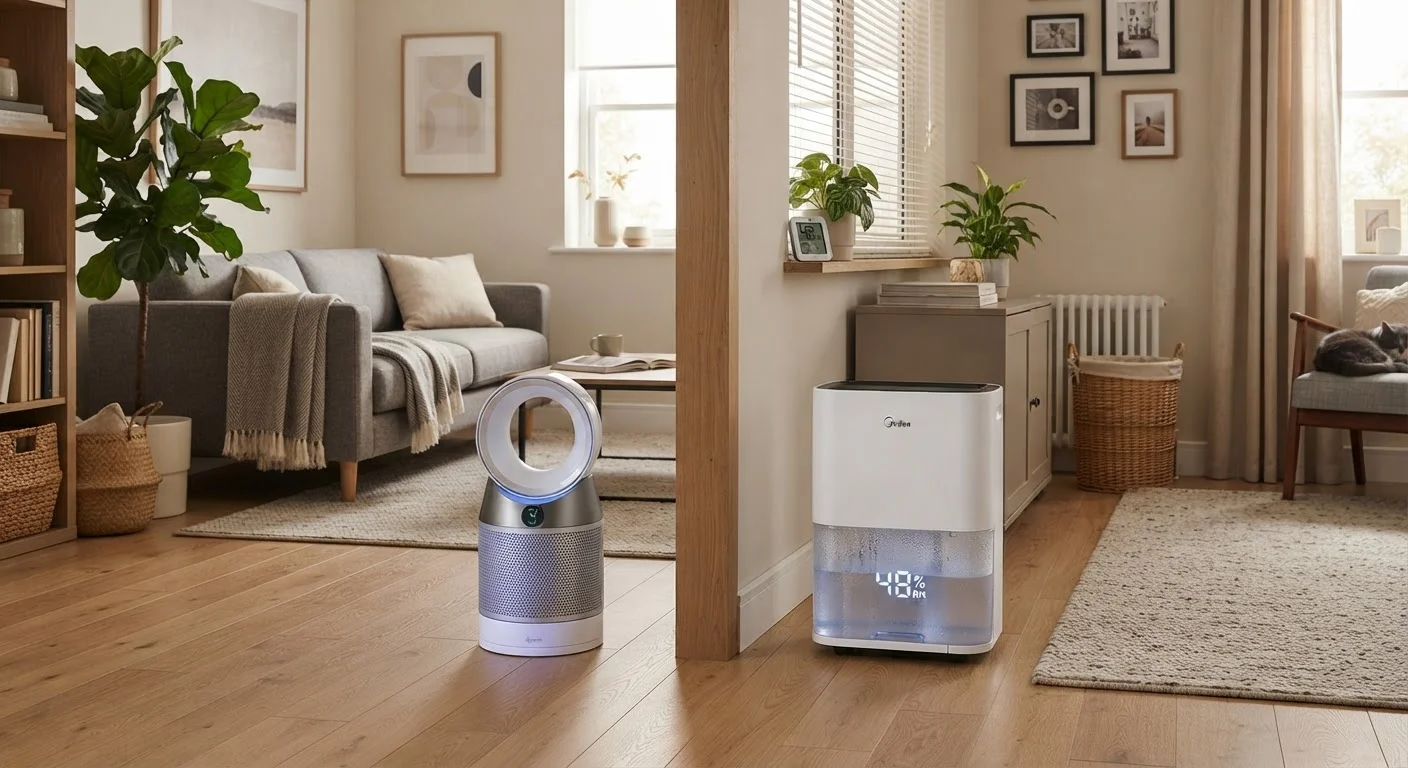
Option A
Air Purifier
The airborne contaminant fighter.
Best for: Homes where occupants experience allergies, asthma, or sensitivity to dust, pet dander, smoke, or airborne pollutants.
Option B
Dehumidifier
The moisture and mold preventer.
Best for: Homes with high indoor humidity, visible condensation, musty odors, or recurring mold and mildew growth.
What Each Device Actually Does
Before deciding between the two, it helps to understand exactly what each appliance is engineered to accomplish - because they work on entirely different principles.
An air purifier moves air through one or more filters to remove contaminants. The most effective residential models use HEPA filters, which are rated to capture at least 99.97% of particles 0.3 microns in size - small enough to catch most pollen, pet dander, mold spores, and fine dust. Some units also include activated carbon layers to adsorb (trap on a surface) odors and chemical gases. Notably, air purifiers do nothing to change the moisture content of your air.
A dehumidifier pulls humid air over refrigerated coils, causing water vapor to condense into liquid, which drains into a reservoir or hose. The resulting drier air is released back into the room. This process reduces relative humidity - the percentage of moisture the air holds relative to its maximum capacity at a given temperature. Most home comfort guidelines suggest keeping indoor humidity between 30% and 50%. Dehumidifiers do not filter particles or purify the air in any meaningful sense.
| Criterion | Air Purifier | Dehumidifier |
|---|---|---|
| Primary function | Removes airborne particles and pollutants | Reduces indoor moisture and humidity |
| Key technology | HEPA and/or activated carbon filters | Refrigerated coils, condensation collection |
| Addresses allergens | Yes - captures pollen, dander, mold spores | Indirectly, by discouraging mold/dust mite growth |
| Addresses mold | Captures spores in the air only | Prevents mold by removing moisture |
| Affects humidity levels | No | Yes - primary purpose |
| Ongoing maintenance | Filter replacement (every 6-12 months typically) | Regular reservoir emptying or drain hose setup |
| Best room types | Bedrooms, living rooms, offices | Basements, laundry rooms, bathrooms |
How to Diagnose Your Home's Problem
The key to choosing correctly is identifying the actual symptom your home is showing. These are not interchangeable solutions - each targets a distinct problem.
Signs You Likely Need an Air Purifier
- Household members frequently sneeze, have itchy eyes, or experience worsened allergy or asthma symptoms indoors
- You have pets and notice dander accumulating on surfaces
- Smoke, cooking odors, or outdoor pollution regularly affects indoor air
- You live near a highway, industrial area, or wildfire-prone region
Signs You Likely Need a Dehumidifier
- Visible condensation on windows, walls, or pipes
- A persistent musty or damp smell in any room
- Mold or mildew appearing on grout, ceilings, or corners
- Warping wood floors or furniture
- A basement or crawl space that feels consistently clammy
An inexpensive hygrometer (a meter that measures relative humidity) can remove all guesswork. If your home reads consistently above 50-55% humidity, a dehumidifier is a logical starting point. If humidity is within range but respiratory symptoms persist, an air purifier may be more appropriate. For broader context on how air quality devices compare in different settings, see our look at air purifier claims in automotive environments, which illustrates how context shapes device performance.
A Note on Air Quality Testing
Consumer-grade indoor air quality monitors vary considerably in accuracy. While they can be useful for tracking general trends - such as whether humidity fluctuates throughout the day - they should not be treated as precise instruments. If you suspect a serious air quality issue, such as elevated radon, carbon monoxide, or volatile organic compounds (VOCs), consult a certified indoor air quality professional for validated testing.
Can One Device Do Both Jobs - and Should You Use Both?
Some manufacturers market combination units that claim to purify air and reduce humidity simultaneously. In practice, these combo devices tend to perform each function less effectively than a dedicated unit. If your budget or space is limited, consider which problem is more urgent and address that one first.
However, there are genuine cases where both devices make sense together. High humidity actively worsens air quality: dust mites thrive above 50% relative humidity, and elevated moisture accelerates mold spore production - both of which become airborne particles an air purifier then has to manage. Tackling humidity with a dehumidifier reduces the load on an air purifier, making both more effective together.
50%
Humidity threshold for dust mite proliferation
According to the U.S. Environmental Protection Agency, relative humidity levels above 50% support dust mite growth, a common indoor allergen source.
90%
Of time Americans spend indoors
The EPA estimates Americans spend approximately 90% of their time indoors, where pollutant concentrations can be two to five times higher than outdoor levels.
When selecting either device, always match the unit's rated coverage area (typically listed in square feet) to the actual size of the room. An undersized unit will run continuously without meaningfully improving conditions.
The content on this site is provided for informational purposes only and should not be considered a substitute for professional advice. While we strive to provide accurate and up-to-date information, we make no guarantees regarding its completeness or accuracy. Always consult a qualified professional for advice specific to your circumstances before making any decisions.