

Start here
What Strength Training Actually Is
Next
How Your Body Adapts in the First 12 Weeks
Then
Core Movements Every Beginner Should Know
Apply it
Structuring Your Training Week
Stay on track
Common Mistakes - and How to Avoid Them
What Strength Training Actually Is
Strength training - also called resistance training - is any form of exercise that requires your muscles to work against an external load. That load can be a barbell, dumbbells, resistance bands, machines, or simply your own bodyweight. The defining feature is progressive overload: gradually increasing the challenge placed on your muscles over time so they continue to adapt.
Unlike cardio, which primarily stresses your cardiovascular system, resistance training targets the neuromuscular system - the partnership between your brain, nerves, and muscles. This distinction matters because it shapes how your body changes and how quickly you notice those changes. For a broader look at how strength work fits alongside other types of movement, the Fitness & Exercise hub is a useful starting point.
Progressive Overload
Gradually increasing the demand placed on your muscles - through more weight, more reps, or less rest - so your body continues to adapt over time.
Hypertrophy
The process by which muscle fibers increase in size in response to consistent resistance training stress.
Compound Movement
An exercise that engages multiple muscle groups and joints at once, such as a squat or row, making it highly efficient for building overall strength.
DOMS
Delayed-onset muscle soreness - the achiness felt 24 to 48 hours after unfamiliar exercise, caused by microscopic stress to muscle fibers during adaptation.
Neural Adaptation
The early phase of strength training progress where your nervous system learns to recruit muscle fibers more efficiently, producing strength gains before muscle size increases.
Posterior Chain
The group of muscles running along the back of the body - including the glutes, hamstrings, and lower back - that are central to posture and functional movement.
How Your Body Adapts in the First 12 Weeks
Beginner adaptations happen in two distinct phases, and understanding both sets realistic expectations.
Weeks 1-4: Neural Adaptation
In the first month, most of your strength gains come not from bigger muscles, but from your nervous system learning to recruit muscle fibers more efficiently. Movements that felt awkward become smoother. You may notice you can lift more within weeks even though your physique hasn't changed - that's neuromuscular learning at work.
Weeks 5-12: Early Hypertrophy and Endurance Gains
From around week five onward, the structural changes begin. Muscle fibers respond to repeated stress by increasing in size - a process called hypertrophy. Endurance within sets improves, recovery between sessions gets faster, and the movements that once exhausted you start to feel manageable. Most people also notice improvements in posture, joint stability, and everyday energy levels during this window.
Track Your Lifts From Day One
Keeping a simple log of the exercises, sets, reps, and weights you use each session makes progressive overload far easier to manage. It also provides a motivating record of how far you've come. A notebook or a free notes app works perfectly - no specialized software is required.
Core Movements Every Beginner Should Know
Effective beginner programs are built around a small number of compound movements - exercises that work multiple muscle groups simultaneously. These deliver the most return on time invested and build a foundation for more specialized training later.
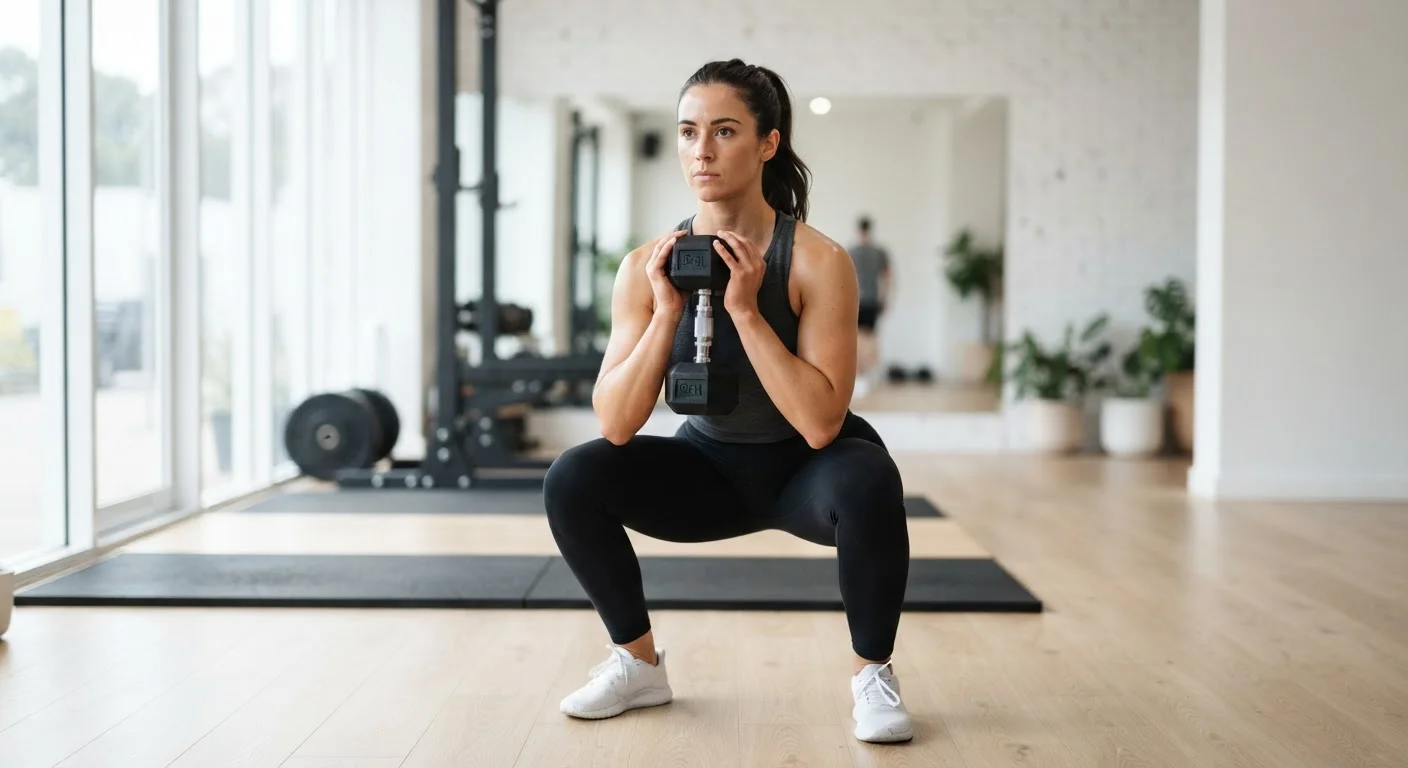
- Squat pattern: Targets the quadriceps, hamstrings, and glutes. Bodyweight squats, goblet squats, or leg press machines are all suitable starting points.
- Hip hinge: Trains the posterior chain - glutes, hamstrings, and lower back. Romanian deadlifts and hip thrusts are beginner-friendly variations.
- Horizontal push: Works the chest, shoulders, and triceps. Push-ups and dumbbell chest press are accessible options.
- Horizontal pull: Develops the back and biceps. Dumbbell rows and resistance band rows build pulling strength with low injury risk.
- Vertical push/pull: Overhead pressing and assisted pull-downs or pull-ups round out shoulder and upper-back development.
If you're weighing whether to train at home or in a gym, our comparison of training at home vs. at a gym covers the practical trade-offs honestly.
Structuring Your Training Week
Two to three full-body sessions per week, separated by at least one rest day, is a well-supported approach for beginners. Full-body programming means each session includes movements from all the major patterns above, ensuring every muscle group gets frequent practice and adequate recovery.
A simple three-day structure might look like: training on Monday, Wednesday, and Friday, with active recovery or light walking on the other days. For those who prefer variety or have specific scheduling needs, our guide to structuring a weekly movement routine outlines flexible frameworks that don't require a gym.
Nutrition and sleep are not optional extras - they are when adaptation actually occurs. Protein intake supports muscle repair, and adequate sleep is essential for hormonal recovery. The Nutrition Basics hub offers evidence-informed guidance on supporting your training through food.
Common Mistakes - and How to Avoid Them
Most beginner setbacks are predictable - and avoidable with a little foresight.
Progressing too fast
Adding weight before your form is consistent is the most common path to injury. A useful rule: only increase load when you can complete all target reps cleanly across all sets.
Skipping warm-up and cool-down
Five to ten minutes of light movement before lifting prepares joints and raises muscle temperature. A brief cool-down helps transition your nervous system out of high output. Neither needs to be elaborate.
Training through sharp pain
Muscle fatigue and mild soreness are expected. Sharp, joint-specific, or sudden pain during a movement is a signal to stop. Persistent pain warrants evaluation by a healthcare or sports medicine professional.
Neglecting recovery
More sessions do not automatically mean faster progress for beginners. Rest days are productive days - tissue repair, neural consolidation, and hormonal recovery all happen away from the gym.
This article provides general health and fitness information for educational purposes only. It is not a substitute for advice from a qualified healthcare or exercise professional. Consult a professional before starting a new exercise program, particularly if you have any existing health conditions or injuries.
Pain Is Not the Same as Effort
There's an important distinction between the discomfort of working hard and pain that signals potential injury. Burning muscles during a set or mild soreness the next day are generally expected. Sharp, stabbing, or joint pain - especially if it persists between sessions - should not be trained through. Consult a qualified professional if you're unsure.
Frequently Asked Questions
Some muscle soreness - called delayed-onset muscle soreness (DOMS) - is normal in the first few weeks and typically peaks 24 to 48 hours after a session. It generally diminishes as your body adapts. Sharp or joint pain during exercise is different and warrants stopping and consulting a professional.
No. Many effective beginner programs can be done at home using bodyweight exercises. Our <a href="/health-wellness/fitness-movement/building-a-weekly-movement-routine-without-a-gym-membership">guide to building a movement routine without a gym</a> outlines how to structure sessions with no equipment. As you progress, resistance bands or dumbbells can add variety.
Strength improvements often come first - within 3 to 4 weeks - as your nervous system becomes more efficient. Visible changes in muscle size typically develop over 8 to 12 weeks with consistent training and adequate nutrition, though this varies by individual.
Resistance training is generally considered beneficial across many age groups, but individual circumstances vary. Anyone with a chronic condition, recent injury, or health concern should consult a qualified healthcare professional before starting a new exercise program.
A widely used starting point is 2 to 3 sets of 8 to 12 repetitions per exercise at a weight that feels challenging by the last few reps. The most important variable early on is showing up consistently, not optimizing volume.
Combining both is generally beneficial for overall health. Light cardio on non-lifting days supports recovery and cardiovascular fitness without interfering with strength adaptations. See our <a href="/beauty-fitness/fitness-exercise">Fitness & Exercise hub</a> for broader guidance on balancing different training types.
The content on this site is provided for informational purposes only and should not be considered a substitute for professional advice. While we strive to provide accurate and up-to-date information, we make no guarantees regarding its completeness or accuracy. Always consult a qualified professional for advice specific to your circumstances before making any decisions.