

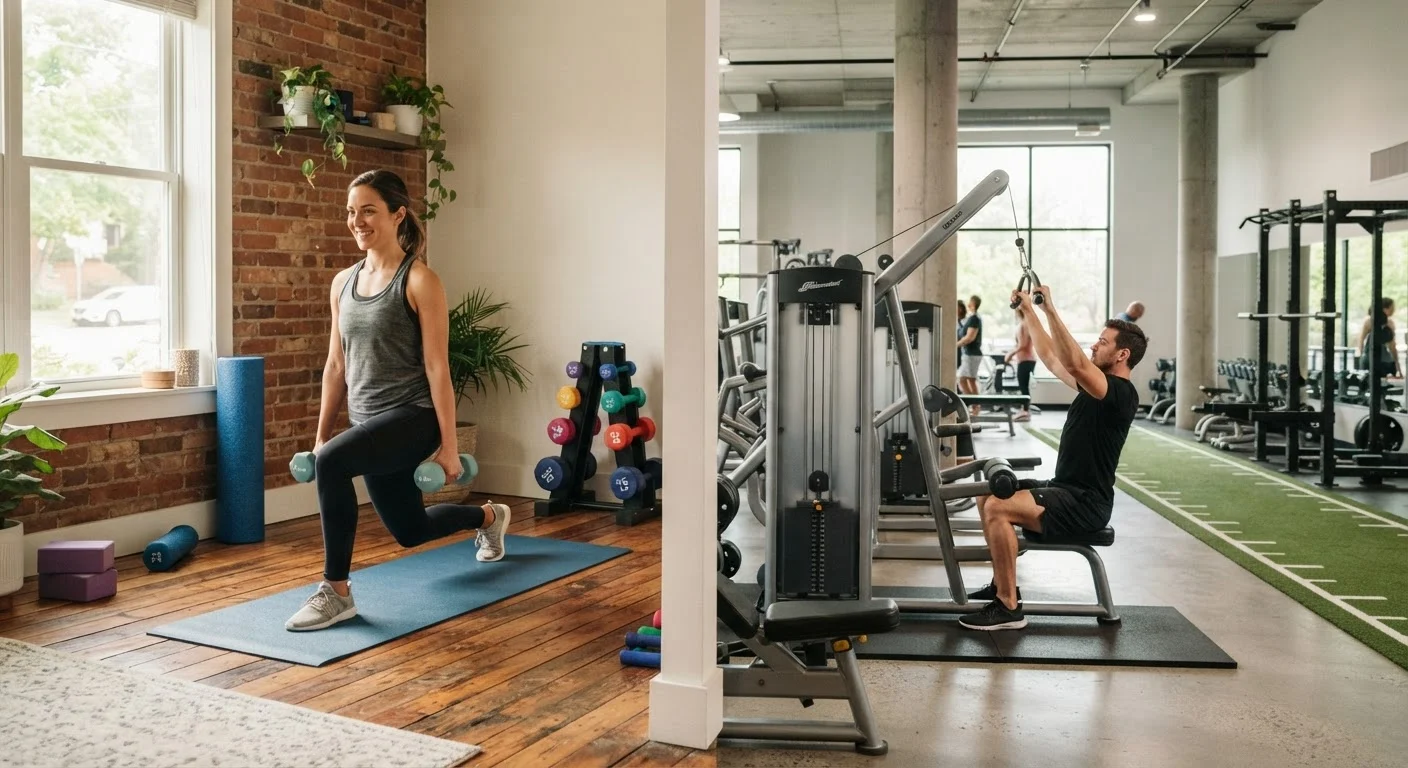
Our Verdict
Neither home training nor gym training is objectively superior - each serves different people at different life stages. Home gyms reward those who are self-motivated and value flexibility, while commercial gyms tend to benefit those who need external structure, community, or access to specialized equipment. Honest self-assessment of your habits, goals, and schedule will point you toward the right fit.
| Best for | Recommended |
|---|---|
| Those with busy or unpredictable schedules | Home Training |
| Beginners who benefit from coaching and community | Gym Training |
| Those pursuing advanced strength or sport-specific goals | Gym Training |
| Those seeking long-term cost savings with adequate space | Home Training |
The Real Question Isn't Which Is Better
The home-vs-gym debate rarely has a clean winner. What matters more is understanding exactly what each environment offers - and which one aligns with how you actually live. Factors like your schedule, training style, budget, and personality all influence which setting will support consistency over time.
It's worth separating the idea of training somewhere from the reality of doing it regularly. A state-of-the-art gym two miles away is less useful than a set of dumbbells in your living room if you never make the drive. Conversely, a home setup gathering dust isn't serving your goals either. The honest answer starts with your habits, not the equipment.
For a broader look at how different training types affect your body regardless of location, see our guide to cardio vs. strength training.
Cost: Upfront vs. Ongoing
Cost comparisons between home and gym training are often misleading because they measure different things. Gym memberships tend to involve modest monthly fees with minimal setup cost, while home gyms require a larger upfront investment that pays off over time.
| Home Training | Gym Training | |
|---|---|---|
| Upfront cost | Moderate to high (equipment) | Low (membership sign-up) |
| Ongoing cost | Minimal after setup | $20-$80/month typically |
| Equipment variety | Limited by space and budget | Broad, including specialty machines |
| Convenience | Very high - no commute | Depends on gym proximity |
| Motivational environment | Self-directed; fewer external cues | Structured; social energy present |
| Best training stage | Intermediate+ with clear goals | Beginners and advanced lifters |
A basic home setup - resistance bands, a pull-up bar, and a pair of adjustable dumbbells - can run a few hundred dollars and last years. A more complete home gym with a barbell, plates, and a rack can cost significantly more. By contrast, gym memberships in the US typically range from around $20 to $80 per month, depending on the facility. Over three to five years, a well-chosen home setup often becomes the more economical option, assuming the equipment gets consistent use.
Hidden costs on both sides are worth considering: gym fees may include initiation charges or class add-ons, while home training involves ongoing costs for accessories, programming apps, and eventually equipment upgrades.
Equipment and Training Variety
Gyms generally win on equipment breadth. Commercial facilities offer cable machines, barbells with heavy plate stacks, cardio machines, benches, and specialty items like leg press or seated row machines that are impractical to own at home. This matters most for intermediate-to-advanced lifters who need progressive overload options across a wide range of movements.
Home training can be surprisingly effective with the right setup. Bodyweight exercises, resistance bands, and adjustable dumbbells cover a broad range of strength and conditioning goals, particularly for beginners and intermediates. Bodyweight training has real strengths and real limits - worth understanding before committing to a minimal equipment approach.
For those with specific goals like powerlifting, sport conditioning, or building significant muscle mass, gym access becomes harder to substitute. For general fitness, flexibility, and bodyweight-based strength, home training covers the essentials well.
Start With What You'll Actually Use
Before purchasing equipment or signing a gym contract, track your current movement habits for two weeks. If you're already exercising consistently at home, a modest equipment investment may be enough. If you've struggled with home routines in the past, a gym trial membership can reveal whether a structured environment suits you better. Either way, starting with what's realistic - not aspirational - tends to produce more durable habits.
Consistency, Motivation, and Environment
Environment shapes behavior more than most people acknowledge. Gyms create a dedicated space associated with exercise - walking in signals your brain to focus. For people who struggle with motivation or find it easy to get distracted at home, the gym's social atmosphere and structured setting can be genuinely valuable.
Home training removes all the friction of getting there - no commute, no waiting for equipment, no social anxiety - but introduces different friction: the couch is nearby, family may interrupt, and there's no ambient energy from others working out. Self-discipline carries more weight at home.
If you're building a routine from scratch, see how to structure a weekly movement plan without a membership for practical frameworks that work at home or outdoors.
Who Each Setting Actually Serves Best
Home training tends to work well for people who are already reasonably self-motivated, have some training experience, and face real logistical barriers to gym attendance - early mornings, childcare, irregular hours, or long commutes. It's also a strong fit for those focused on general fitness rather than sport-specific performance.
Gym training is often better suited to beginners who benefit from access to guidance, beginners exploring what to expect in early strength training, and those whose goals require heavy compound lifts or specialized equipment. The social dimension - group classes, workout partners - also helps some people stay accountable in ways that are harder to replicate at home.
A hybrid approach - maintaining a modest home setup for short sessions and visiting a gym for heavier or more varied training - is increasingly practical and removes the need to choose entirely. The Fitness & Movement hub offers further guidance on structuring a sustainable routine in either setting.
This article is for informational purposes only and is not a substitute for advice from a qualified fitness or healthcare professional. Individuals with health conditions or injuries should consult a professional before beginning or modifying any exercise program.
The content on this site is provided for informational purposes only and should not be considered a substitute for professional advice. While we strive to provide accurate and up-to-date information, we make no guarantees regarding its completeness or accuracy. Always consult a qualified professional for advice specific to your circumstances before making any decisions.