

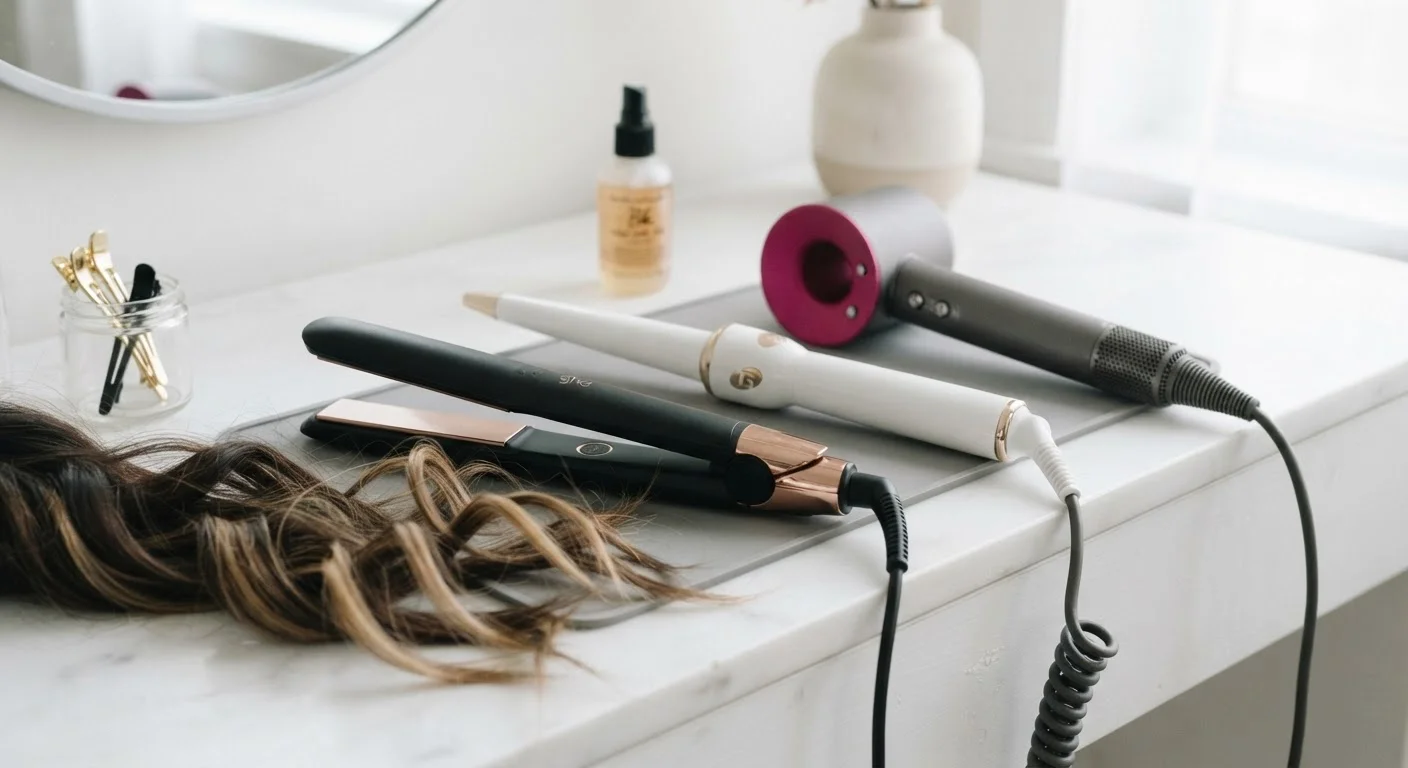
Why Heat Frequency Is a Hair-Type Question
There is no universal answer to how often heat styling is safe. The same flat iron used daily on thick, coarse hair may cause relatively little visible damage, while that same routine could leave fine or chemically treated hair brittle within weeks. Heat tolerance is shaped by your hair's porosity, diameter, structural integrity, and current condition.
Heat tools - flat irons, curling wands, and blow dryers - work by temporarily breaking hydrogen bonds within the hair shaft, allowing the strand to be reshaped. The risk comes from applying temperatures high enough, or frequently enough, to cause cumulative protein degradation and moisture loss that the hair cannot recover from between sessions.
If you're unsure whether your current routine is working for you, it's worth reviewing the warning signs that a hair routine needs a reset before adjusting your heat habits.
| Recommended max temperature for fine hair | Below 300°F (150°C) (General professional consensus) |
| Recommended max temperature for medium hair | Below 375°F (190°C) (General professional consensus) |
| Safe heat styling frequency for chemically treated hair | Once per week or less (General stylist guidance) |
| Safe heat styling frequency for fine hair | 1-2 times per week (General professional consensus) |
| Safe heat styling frequency for medium/normal hair | 2-3 times per week (General professional consensus) |
| Hair type most vulnerable to heat damage | Chemically treated and tightly coiled hair |
General Frequency Guidelines by Hair Type
The following reflects general guidance drawn from hair science and professional consensus. Individual results will vary based on tool temperature, technique, and protective measures used.
Hair porosity
Porosity refers to how readily your hair absorbs and retains moisture. High-porosity hair has a more open cuticle and takes in moisture easily but loses it quickly; low-porosity hair resists absorption but retains moisture longer once hydrated.
Cuticle
The cuticle is the outermost layer of the hair shaft, made of overlapping scale-like cells. It protects the inner cortex and determines how much shine, smoothness, and structural integrity a strand has.
Cortex
The cortex is the middle layer of the hair shaft and makes up most of its bulk. It contains keratin protein and melanin pigment, and its condition largely determines the hair's strength and elasticity.
Thermal damage
Thermal damage occurs when heat exposure alters or breaks down the protein structure within the hair shaft, leading to symptoms like dryness, brittleness, loss of curl pattern, and increased breakage.
Heat protectant
A heat protectant is a styling product applied before heat tool use to reduce direct thermal contact with the hair shaft. Common formulations include silicone-based sprays, creams, and serums.
Fine or Low-Density Hair
Fine hair has a smaller cortex, meaning it holds less structural protein and reaches damaging temperatures faster. Heat styling more than once or twice per week - even with protective products - is commonly associated with increased breakage and loss of elasticity in this hair type.
Medium or Normal Hair
Medium-diameter strands with normal porosity tend to tolerate moderate heat use better. Two to three times per week at appropriate temperatures (typically below 375°F / 190°C) is a range many professionals consider manageable, provided a quality heat protectant is used consistently.
Thick or Coarse Hair
Coarser hair often requires higher temperatures to achieve results, but its larger cortex provides more structural mass. The risk of thermal damage is not absent - overuse still degrades the cuticle - but this hair type is generally more resilient to moderate frequency.
Curly or Textured Hair (Type 3-4)
Naturally curly and tightly coiled hair tends to be drier due to sebum having difficulty traveling along the coiled shaft. This makes it more vulnerable to heat damage even at lower temperatures. Many stylists advise limiting heat styling to once a week or less, and prioritizing protective options such as those outlined in our guide to protective styling principles that genuinely preserve hair health.
Chemically Treated or Bleached Hair
Color-treated, permed, relaxed, or bleached hair has already undergone structural changes. Its protein bonds and moisture barriers are compromised, making it the most heat-sensitive category. Experts frequently recommend limiting heat styling to once per week or less, and using the lowest effective temperature setting.
Practices That Affect How Much Frequency Matters
Frequency alone does not determine damage. How you use heat tools is equally - sometimes more - important than how often you reach for them.
- Heat protectants: Products containing ingredients like silicones or heat-stable polymers create a barrier that reduces direct thermal contact with the cuticle. Applying one consistently before any heat styling is one of the most evidence-supported practices for reducing cumulative damage.
- Temperature settings: Using the lowest temperature that achieves your desired result is a meaningful harm-reduction strategy. Higher settings beyond what your hair needs add risk without benefit.
- Passes and dwell time: Passing a flat iron over the same section repeatedly or holding a curling wand in place for too long concentrates heat damage. Single efficient passes are preferable.
- Air drying first: Starting a blow-dry session on soaking wet hair extends heat exposure significantly. Allowing hair to air dry to 70-80% before using a dryer reduces the total thermal load.
230°C+
Temperature threshold where keratin protein degradation accelerates
Research in hair biology indicates significant protein changes occur above approximately 230°C (446°F), underscoring the importance of appropriate temperature control.
~70-80%
Air-dry level recommended before blow-drying
Many professional stylists advise allowing hair to reach this moisture level before applying a blow dryer to reduce total thermal exposure.
None of these practices eliminates risk entirely, but they meaningfully shift the equation. Pairing smart technique with an appropriate frequency for your hair type is more protective than frequency reduction alone.
This article is for general informational purposes only and does not constitute professional cosmetology or medical advice. Consult a licensed stylist for personalized guidance on your hair's specific needs.
The content on this site is provided for informational purposes only and should not be considered a substitute for professional advice. While we strive to provide accurate and up-to-date information, we make no guarantees regarding its completeness or accuracy. Always consult a qualified professional for advice specific to your circumstances before making any decisions.