

Why Movement Patterns Matter More Than Exercises
Most people think about their workouts in terms of specific exercises - a bicep curl here, a leg press there. But fitness coaches and exercise scientists tend to think in a different currency: movement patterns. Rather than cataloguing hundreds of individual exercises, movement-pattern thinking groups them by how the body actually moves.
This framework matters because the human body has a finite set of ways it can move efficiently and safely. When your training consistently covers all of them, you develop balanced strength and reduce the risk of overuse injuries that stem from favouring some muscle groups while neglecting others. If you're just starting to build a workout routine, understanding these six patterns gives you a ready-made compass for structuring sessions that cover all your bases - no specialist knowledge required.
The six foundational patterns covered here appear across fitness and movement guidance for good reason: they reflect how the body is designed to work, both in the gym and in daily life.
Push
Push movements involve driving a load or your own bodyweight away from your body - either horizontally (as in a press-up) or vertically (as in an overhead press). These exercises primarily train the chest, shoulders, and triceps, while also requiring stabilisation from the core and upper back.
A balanced push pattern includes both horizontal and vertical planes of motion. Relying exclusively on one direction - horizontal pressing in particular - can contribute to shoulder imbalances over time, so varying your push work pays dividends for joint health as well as strength.
Push movements span both horizontal and vertical planes - training both prevents shoulder imbalances.
Pull
Pull movements are the counterpart to pushing: you're drawing a load toward your body or moving your body toward a fixed point, as in a row or a pull-up. The primary muscles involved are the back (particularly the lats and rhomboids), biceps, and rear shoulders.
In many people's programmes, pulling volume is chronically lower than pushing volume, which can lead to rounded shoulders and upper-back weakness. Most exercise physiologists recommend matching - or even slightly exceeding - pull volume relative to push volume to maintain healthy posture and shoulder function.
Most programmes under-train pulling - matching pull to push volume supports better posture and shoulder health.
Hinge
The hip hinge is a foundational movement in which the hips drive backward while the spine remains neutral - think of a deadlift or a Romanian deadlift. It trains the posterior chain: glutes, hamstrings, and lower back. This muscle group is critical not just for athletic performance but for the kind of everyday tasks (lifting, bending, picking things up) where injuries are common.
Learning a clean hinge pattern is often considered a prerequisite for safe loading of the lower body. Starting with a bodyweight hinge or a light dumbbell variation lets you develop motor control before progressing to heavier loads.
A clean hip hinge pattern is the foundation of safe lower-body loading and injury prevention.
Squat
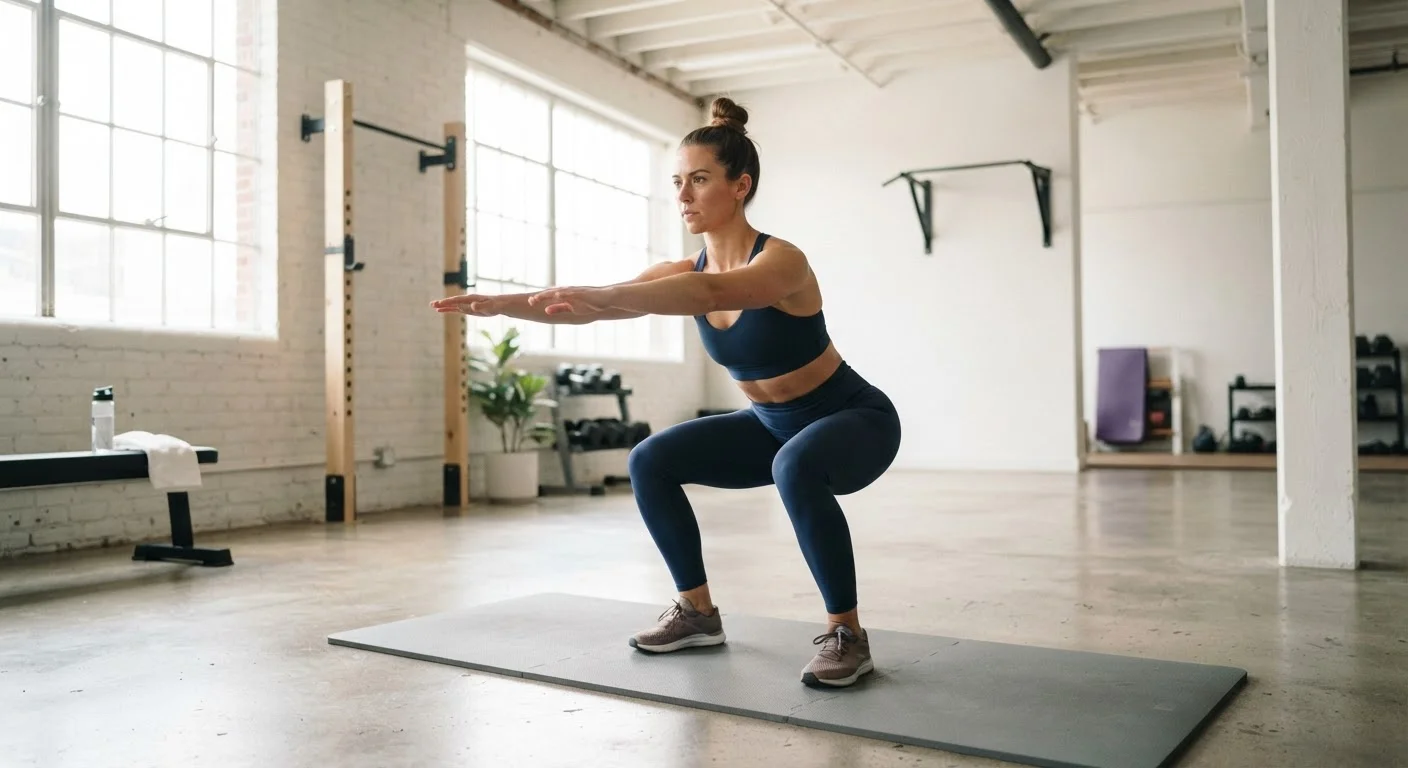
The squat pattern involves the knees and hips bending simultaneously to lower and raise the body's centre of mass - as in a bodyweight squat, goblet squat, or split squat. Unlike the hinge, which emphasises the posterior chain, squats distribute work more evenly across the quadriceps, glutes, and hamstrings, while demanding significant core stability and ankle mobility.
Squat variations are among the most versatile patterns in training: they can be scaled from a simple chair-assisted squat for beginners up to heavily loaded barbell variations. Both hinge and squat patterns should feature in a complete programme - they are complementary, not interchangeable.
Squats and hinges are complementary, not interchangeable - a complete programme needs both.
Carry
Carry movements involve holding a load and moving through space - a farmer's carry (weights held at the sides) being the most common example. Carries train grip strength, shoulder stability, core anti-rotation, and general full-body endurance simultaneously. They're also remarkably functional: carrying groceries, luggage, or a child all demand the same qualities.
Despite their simplicity, carries are frequently omitted from training programmes. They require no technical complexity, make a useful finisher at the end of a session, and can be performed with almost any load - including a loaded backpack if no weights are available.
Carries are among the most functional and overlooked patterns - they train grip, core, and endurance at once.
Rotate
Rotational movements involve turning or resisting rotation through the torso - from a cable woodchop or a medicine ball throw to simply bracing against rotation during a single-arm row. The core's deepest function is not just flexion (crunches) but controlling and generating rotation, which is central to nearly every sport and many everyday activities.
There are two sides to rotational training worth developing: producing rotation (swinging, throwing, chopping) and resisting rotation (anti-rotation presses, single-side carries). Both are valuable. Many general fitness programmes skip this pattern entirely in favour of more visible core exercises - an oversight that can limit both performance and spinal resilience.
Both producing and resisting rotation are trainable skills - neglecting either limits core function and resilience.
Putting the Patterns Together
The real value of this framework is how it simplifies programme design. Rather than worrying about whether you've done enough exercises, you can ask a simpler question: did I cover all six patterns this week? A balanced week of training might pair push with pull on one day, hinge with squat on another, and use carries and rotation as supporting movements throughout.
Audit Your Current Programme
Review your recent workouts and note which of the six patterns each exercise falls into. Gaps in your pattern coverage - a week without any pulling, for example - are often the root cause of plateaus or nagging discomfort. Filling those gaps doesn't require overhauling your programme; adding one or two targeted movements is usually enough.
You don't need to hit every pattern in every session - that's the point. Distributing patterns across a weekly plan gives each movement type adequate volume and recovery time. And because all six patterns can be trained without a gym, they translate well to home or outdoor movement routines too.
If you're new to resistance training, learning what to expect in your first weeks of strength training can help you apply these patterns with realistic expectations. Movement-pattern literacy is a long-term investment - one that pays off every time you step into a new training environment.
This article is for general informational purposes only and does not constitute personal fitness or medical advice. Consult a qualified fitness professional or healthcare provider before beginning a new exercise programme, particularly if you have existing injuries or health conditions.
The content on this site is provided for informational purposes only and should not be considered a substitute for professional advice. While we strive to provide accurate and up-to-date information, we make no guarantees regarding its completeness or accuracy. Always consult a qualified professional for advice specific to your circumstances before making any decisions.