

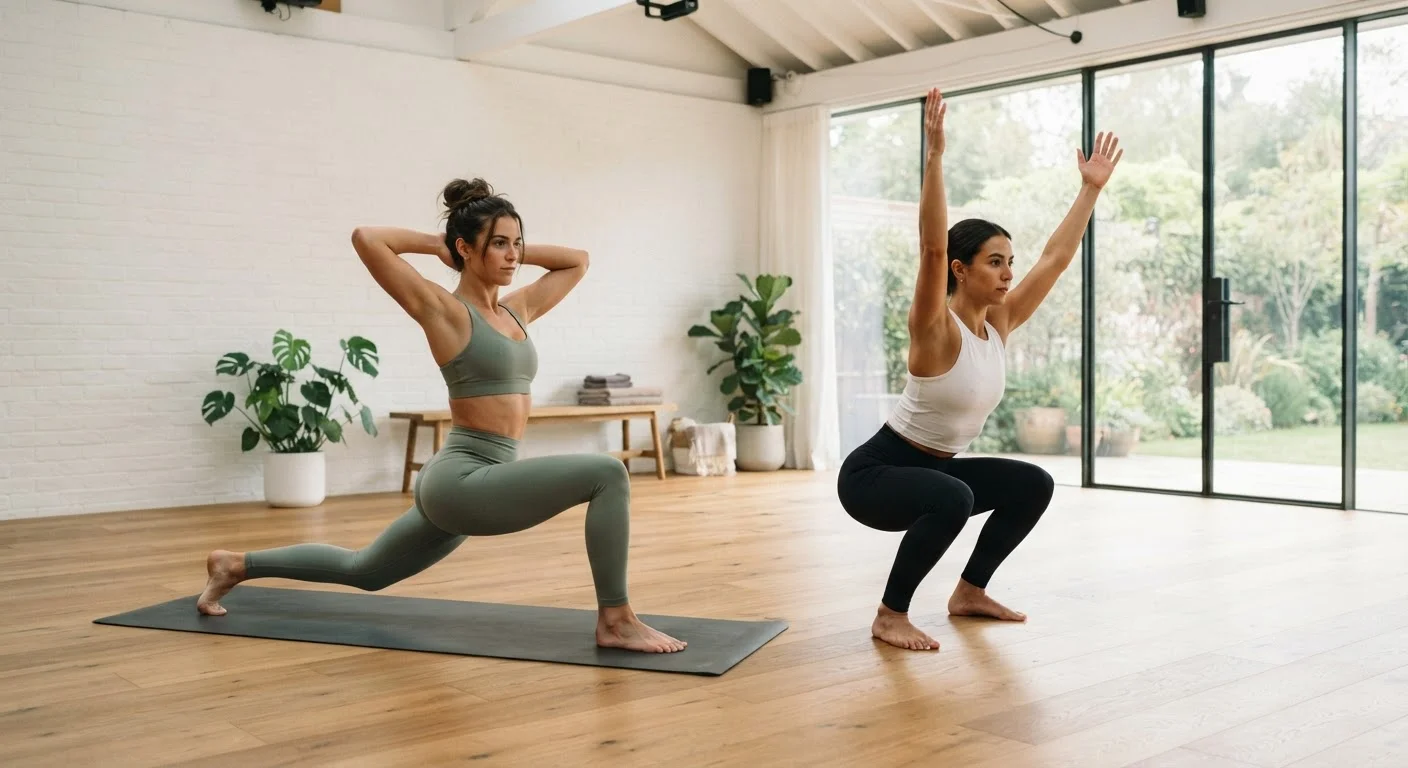
Option A
Flexibility
The passive range your muscles can reach.
Best for: People looking to reduce muscle tension, improve posture, and lengthen tight tissue through sustained stretching.
Option B
Mobility
The active range you can control and use.
Best for: People who want functional movement quality, joint health, and strength through a full range of motion.
What Each Term Actually Means
Flexibility and mobility are used interchangeably in everyday conversation, but they describe meaningfully different physical qualities. Getting clear on the distinction helps you train more intentionally and understand what your body actually needs.
Flexibility is the ability of a muscle or muscle group to passively lengthen. When you sit on the floor and reach toward your toes, the sensation you feel in your hamstrings - that pull or limitation - reflects your current flexibility. It is a property of the soft tissue itself: muscles, tendons, and fascia.
Mobility is the ability of a joint to move actively through its full range of motion with control. It involves not just tissue length but also neuromuscular coordination, joint health, and the strength to own that range. A hip with good mobility can reach depth in a squat and stay stable under load - not just stretch passively on a mat.
A useful way to think about it: flexibility is a component of mobility, but mobility is a broader capacity. You might have flexible hamstrings yet lack the hip and thoracic mobility to perform a deadlift with a neutral spine. The tissue can lengthen, but the system can't coordinate the movement.
| Criterion | Flexibility | Mobility |
|---|---|---|
| Core definition | Passive muscle lengthening capacity | Active joint range with control |
| Primary tissue involved | Muscles, tendons, fascia | Joints, neuromuscular system, muscles |
| How it's trained | Static and PNF stretching | Active movement, loaded range work |
| Carryover to daily function | Moderate - reduces tension and stiffness | High - directly improves movement quality |
| Can you have it without the other? | Yes - flexible but lacking joint control | Partially - mobility needs some flexibility |
| Equipment needed | None required | None required; resistance optional |
How They're Trained Differently
Because flexibility and mobility involve different physical mechanisms, they respond to different types of training.
Flexibility is typically developed through static stretching - holding a position for 20 to 90 seconds to encourage tissue lengthening over time. Techniques like proprioceptive neuromuscular facilitation (PNF), where you contract and then relax a muscle before deepening a stretch, are also widely used. The goal is to reduce the passive resistance in the tissue.
Mobility is trained through active, often loaded movement. Exercises like controlled articular rotations (CARs), deep squat holds with active engagement, and strength work performed through a full range of motion all build joint capacity. The aim is to develop strength and neuromuscular control across the full arc of a joint's movement - not just reach a passive end range.
This is why traditional stretching alone rarely solves movement problems. If your hip flexors are tight and you only stretch them passively, you may gain some length - but without strengthening the opposing muscles and training the joint to move actively through that new range, the body often defaults back to its old patterns.
Passive vs. Active Range: A Key Distinction
Your passive range of motion - how far a limb can be moved with external assistance - is almost always greater than your active range. Mobility training aims to close that gap by building strength and control through the full spectrum of movement your joints are capable of. A wide gap between passive and active range can indicate an area worth focused attention in training.
For practical ideas on structuring movement work into your week, see our Fitness & Movement hub for accessible guidance across training topics.
Why Both Deserve a Place in Your Routine
Neither flexibility nor mobility is inherently more important - they serve complementary roles. A body that is flexible but lacks mobility may have long muscles that aren't particularly functional under load. A body trained only for mobility without adequate tissue length may face unnecessary tension limiting joint range.
Research consistently supports the value of both qualities for long-term health. Reduced joint mobility is associated with a higher risk of musculoskeletal injury, and poor flexibility in key muscle groups can contribute to postural imbalances and discomfort. Both qualities also decline progressively with age and inactivity, but both respond well to consistent, targeted training.
A practical approach combines static or dynamic stretching for tissue length with active movement work for joint control. Even brief daily practice - 10 to 15 minutes of intentional movement - can produce meaningful improvements over months. The training environment you choose matters less than consistency; both flexibility and mobility work can be done effectively at home with no equipment.
If you're dealing with a specific movement limitation, pain, or recovering from injury, consult a physiotherapist or qualified movement professional before designing a program. General information like this is a starting point - not a substitute for individualized assessment.
This article is for general informational and educational purposes only and does not constitute medical or professional health advice. Always consult a qualified healthcare or movement professional for personal guidance.
The content on this site is provided for informational purposes only and should not be considered a substitute for professional advice. While we strive to provide accurate and up-to-date information, we make no guarantees regarding its completeness or accuracy. Always consult a qualified professional for advice specific to your circumstances before making any decisions.