

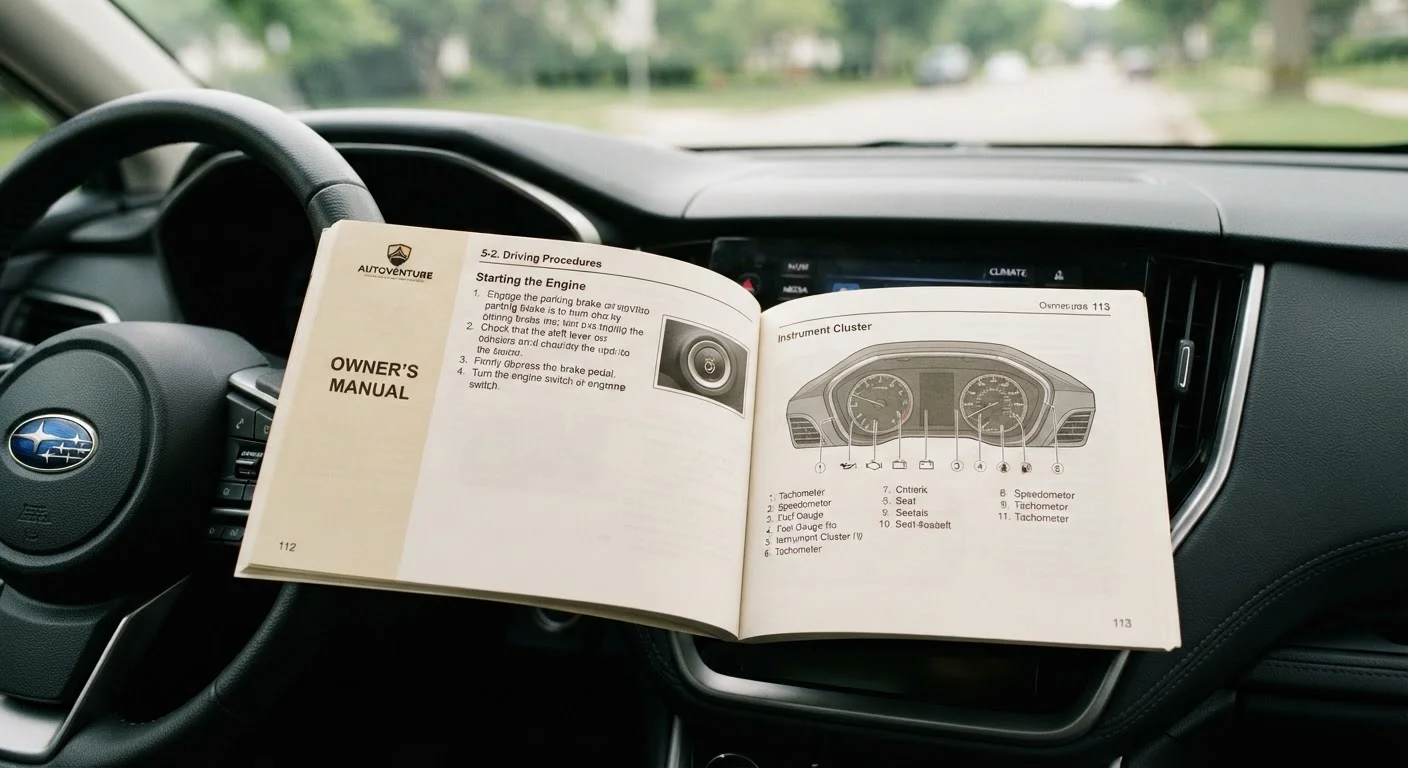
Why the Owner's Manual Gets Ignored - and Why That's a Problem
For most drivers, the owner's manual is filed away on day one and never consulted again. It's dense, it's not exciting, and general car advice feels close enough. But that assumption carries a hidden cost.
Manufacturers engineer each vehicle to specific tolerances - and the manual is the single document that captures those requirements in detail. Oil viscosity, service intervals, tire pressures, fluid types: these vary by model, engine, and even production year. No generic article or well-meaning forum post can substitute for the specifications your vehicle was actually designed around.
First-time owners especially benefit from treating the manual as a practical reference rather than a regulatory document. If you're newer to ownership, our guide for first-time car owners covers the broader fundamentals - but the manual is always where the specifics live.
Mark the Sections You'll Actually Use
Use sticky tabs or bookmarks to flag the maintenance schedule, fluid specifications, and warning light index in your manual. These three sections will answer the vast majority of routine questions that come up during ownership - and having them marked saves time when you need answers fast.
What to Actually Do With Your Manual: Step-by-Step
What you will need
The steps below walk you through the five most practically valuable sections of a typical owner's manual. You don't need to read the entire document cover to cover - you need to know where the critical information is and what it means for your day-to-day ownership.
Owner's Manual
The primary reference document for all vehicle-specific maintenance, fluid specs, and warning light interpretation.
Tire Pressure Gauge
Used to verify tire inflation matches the manufacturer's specified PSI found in the manual or door jamb label.
Notepad or Notes App
For recording key intervals, fluid specs, and service dates as you read through the manual.
Locate and Identify Your Manual
Most owner's manuals live in the glove box, though some vehicles store them in the center console or a door pocket. If your copy is missing, the manufacturer's official website typically offers a free PDF download - search using your vehicle's year, make, and model.
Confirm the manual matches your specific trim and engine variant. Some manuals cover multiple configurations in one volume, so note the applicable sections for your exact setup before reading.
Find and Read the Maintenance Schedule
The maintenance schedule is usually located toward the back of the manual. It lists service intervals - expressed in miles or months, whichever comes first - for items like engine oil, transmission fluid, brake fluid, coolant, spark plugs, air filters, and timing belts or chains.
Note the specific intervals for your driving conditions. Most manuals distinguish between normal and severe driving - the latter applies if you regularly drive in stop-and-go traffic, dusty environments, or extreme temperatures. Many urban drivers actually fall into the severe category.
Confirm the Correct Fluid Specifications
Your manual specifies the exact oil viscosity grade (such as 5W-30 or 0W-20), transmission fluid type, brake fluid specification, and coolant type for your vehicle. These are not interchangeable - using the wrong fluid can reduce component lifespan or, in some cases, cause damage.
Cross-check this section the next time you top off any fluid. The information on the product packaging must match what your manual lists, not just a general recommendation from a store associate or generic online source.
Check the Recommended Tire Pressure
The correct tire pressure for your vehicle is printed on the driver's door jamb sticker and referenced in the owner's manual - it is not the maximum pressure printed on the tire sidewall itself. These are different numbers, and using the sidewall figure as your target is a common mistake.
Check pressure when the tires are cold (the vehicle hasn't been driven for at least three hours), as driving heats the air inside and temporarily raises the reading. For more on interpreting pressure warnings, see our guide on reading your TPMS warning light.
Review the Warning Light Index
Almost every owner's manual includes a dedicated section illustrating each dashboard warning and indicator light, with an explanation of what it means and the recommended response. This section is one of the most practically valuable in the entire document.
Spend a few minutes familiarizing yourself with the icons before a warning appears - it's far easier to recall their meaning calmly in advance than to interpret an unfamiliar symbol while already concerned. Pay particular attention to lights that require immediate action versus those that signal a scheduled service need.
Note Any Model-Specific Cautions
Many manuals include model-specific sections addressing known operational quirks, features that require special handling, or limits on towing, payload, and roof load. These sections are easy to skip but can carry real consequences if overlooked.
If your vehicle has a turbocharger, hybrid powertrain, or all-wheel drive system, there are likely dedicated subsections addressing how to operate and maintain these systems correctly. Generic car advice frequently omits these nuances - which is exactly why the manual matters. For a broader look at separating fact from friction in car care, see common car maintenance myths.
Don't Rely Solely on Generic Advice
Maintenance recommendations vary significantly between makes, models, and model years. A well-intentioned tip that applies to one vehicle - such as an oil change interval or a fluid specification - may be actively wrong for yours. Always cross-reference general advice against your specific owner's manual before acting on it.
Ignoring Warning Lights Is a Risk
Some dashboard warning lights indicate conditions that can cause rapid and serious mechanical damage if ignored. Never assume a light is a minor sensor glitch without first identifying its meaning in your owner's manual. When in doubt, have the vehicle inspected by a qualified mechanic promptly.
Putting It Into Practice
Reading through the relevant sections of your owner's manual once, with a notepad handy, is a straightforward task most drivers can complete in under an hour. The payoff is disproportionate: knowing your correct service intervals, fluid specs, and warning light meanings puts you in a far better position to catch problems early and avoid repairs driven by misinformation.
The manual also becomes a useful filter when evaluating advice. If a tip conflicts with what your manufacturer specifies - whether it's a popular oil-change myth or an outdated break-in procedure - you'll have the grounding to question it. For more on separating durable car care knowledge from folklore, see our piece on car maintenance myths.
Finally, if you're evaluating a used vehicle and the manual is missing, that's worth noting. A complete service history and accompanying documentation are markers of a well-cared-for vehicle - context our article on decoding car ad language explores in more depth.
The content on this site is provided for informational purposes only and should not be considered a substitute for professional advice. While we strive to provide accurate and up-to-date information, we make no guarantees regarding its completeness or accuracy. Always consult a qualified professional for advice specific to your circumstances before making any decisions.